Use Parakeet if you speak one of its 25 languages (English, most EU languages, Russian and Ukrainian): it is small, auto-detects the language, and NVIDIA's published accuracy is strong. Use Whisper for any other language, or to compare results on difficult audio. On iPhone, Whisper Small is a sensible start; Large Turbo is for recent devices.
I make ScribeKit, which ships Parakeet built in and offers Whisper as optional downloads, so weigh my view accordingly. Every accuracy number below comes from the publishers' own model cards and announcements, measured on their hardware and test sets. I have not published measurements from a phone, so this post contains no speed or battery figures of my own.
What is NVIDIA Parakeet TDT 0.6B v3?
Parakeet TDT 0.6B v3 is a 600-million-parameter speech recognition model that NVIDIA released on Hugging Face on 14 August 2025. It pairs a FastConformer encoder with a TDT (token-and-duration transducer) decoder. Version 3 extends the English-only v2 to 25 European languages.
What the model card says it does:
- Languages: Bulgarian, Croatian, Czech, Danish, Dutch, English, Estonian, Finnish, French, German, Greek, Hungarian, Italian, Latvian, Lithuanian, Maltese, Polish, Portuguese, Romanian, Slovak, Slovenian, Spanish, Swedish, Russian and Ukrainian.
- Language detection: it "automatically detects the language of the audio and transcribes it without requiring additional prompting." There is no language setting to get wrong.
- Output: automatic punctuation and capitalization, plus word-level and segment-level timestamps.
- Training data: primarily NVIDIA's Granary multilingual corpus.
- License: CC BY 4.0, which allows commercial use with attribution.
Two details from the card are worth knowing. The Portuguese training data is European Portuguese, while most benchmarks use Brazilian Portuguese, so NVIDIA notes the published Portuguese numbers may partly reflect that difference. And the card is frank that "Transcripts may be not 100% accurate. Accuracy varies based on language and characteristics of input audio."
NVIDIA's technical report has the full method for anyone who wants the training and evaluation details.
How accurate is Parakeet, according to NVIDIA?
These are NVIDIA's numbers from the model card: word error rate (WER, lower is better), greedy decoding, with punctuation and capitalization removed before scoring. They were measured on NVIDIA's setup, not on an iPhone, and they are averages over test sets that may not sound like your recordings.
On the English benchmarks of the Hugging Face Open ASR Leaderboard, NVIDIA reports an average WER of 6.34%: 1.93% on LibriSpeech test-clean (read audiobooks), 3.59% on LibriSpeech test-other, and 11.31% on AMI (real meetings). The gap between audiobooks and meetings is the most useful number here: conversational, multi-speaker audio is much harder for every model.
Across languages, the FLEURS average is 11.97%, with a wide spread. A selection:
| Language | FLEURS WER (NVIDIA) |
|---|---|
| Italian | 3.00% |
| Spanish | 3.45% |
| Portuguese | 4.76% |
| English | 4.85% |
| German | 5.04% |
| French | 5.15% |
| Russian | 5.51% |
| Ukrainian | 6.79% |
| Polish | 7.31% |
| Dutch | 7.48% |
| Swedish | 15.08% |
| Danish | 18.41% |
| Greek | 20.70% |
| Latvian | 22.84% |
| Slovenian | 24.03% |
The takeaway: for the large Western European languages plus Russian and Ukrainian, NVIDIA's own numbers are low single digits. For smaller languages such as Latvian, Slovenian, Greek or Danish, errors are several times higher. If you transcribe in one of those, it is worth trying a Whisper model on the same recording and comparing.
What is OpenAI Whisper, and which sizes exist?
Whisper is OpenAI's open speech recognition model, described in the paper "Robust Speech Recognition via Large-Scale Weak Supervision" and released with its code and weights under the MIT License on GitHub. The original models were trained on 680,000 hours of audio, including 117,000 hours in 96 other languages; the model's tokenizer recognizes 99 languages, and large-v3 added Cantonese, which is how you arrive at the "about 100 languages" figure apps quote.
OpenAI's size table:
| Size | Parameters | English-only version |
|---|---|---|
| tiny | 39 M | Yes |
| base | 74 M | Yes |
| small | 244 M | Yes |
| medium | 769 M | Yes |
| large (v1, v2, v3) | 1550 M | No |
| turbo (large-v3-turbo) | 809 M | No |
The large-v3 model card says it was trained on 1 million hours of weakly labeled audio and 4 million hours of pseudo-labeled audio, and shows "10% to 20% reduction of errors compared to Whisper large-v2" across a wide range of languages.
Large-v3-turbo, released in October 2024, is the one that matters most on phones. Its model card calls it "the exact same model, except that the number of decoding layers have reduced from 32 to 4," and says it is "way faster, at the expense of a minor quality degradation." In the release announcement, OpenAI says that "across languages, the turbo model performs similarly to large-v2," with "larger degradation on some languages like Thai and Cantonese."
The Whisper cards are just as frank as NVIDIA's. They note that the models "show strong ASR results in ~10 languages," perform unevenly across languages and accents, and, because of how they were trained, may produce "texts that are not actually spoken in the audio input (i.e. hallucination)." OpenAI publishes per-language error rates for large-v3 and large-v2 on Common Voice 15 and FLEURS as a chart in the GitHub README; check your language there before relying on it.
One caveat on OpenAI's "relative speed" column, which you will see copied around: OpenAI says those speeds were "measured by transcribing English speech on a A100," a data-centre GPU. They tell you nothing reliable about an iPhone.
What does a word error rate mean in practice?
WER counts the words a model gets wrong (substituted, dropped or added) as a share of the words actually spoken. A 5% WER means roughly one word in twenty needs fixing; at 20%, it is one in five, which is closer to a rough draft than a transcript.
Three things make published WERs look better than your recordings will. Benchmark audio is usually clean and recorded close to the microphone. Scores are computed after stripping punctuation and capitalization, which a real transcript needs. And the averages hide the hard cases: names, jargon, people talking over each other. Treat the numbers as a ranking between models on the same test, not a promise about your lecture or interview, and always check quotes against the audio.
Which Whisper models does ScribeKit offer?
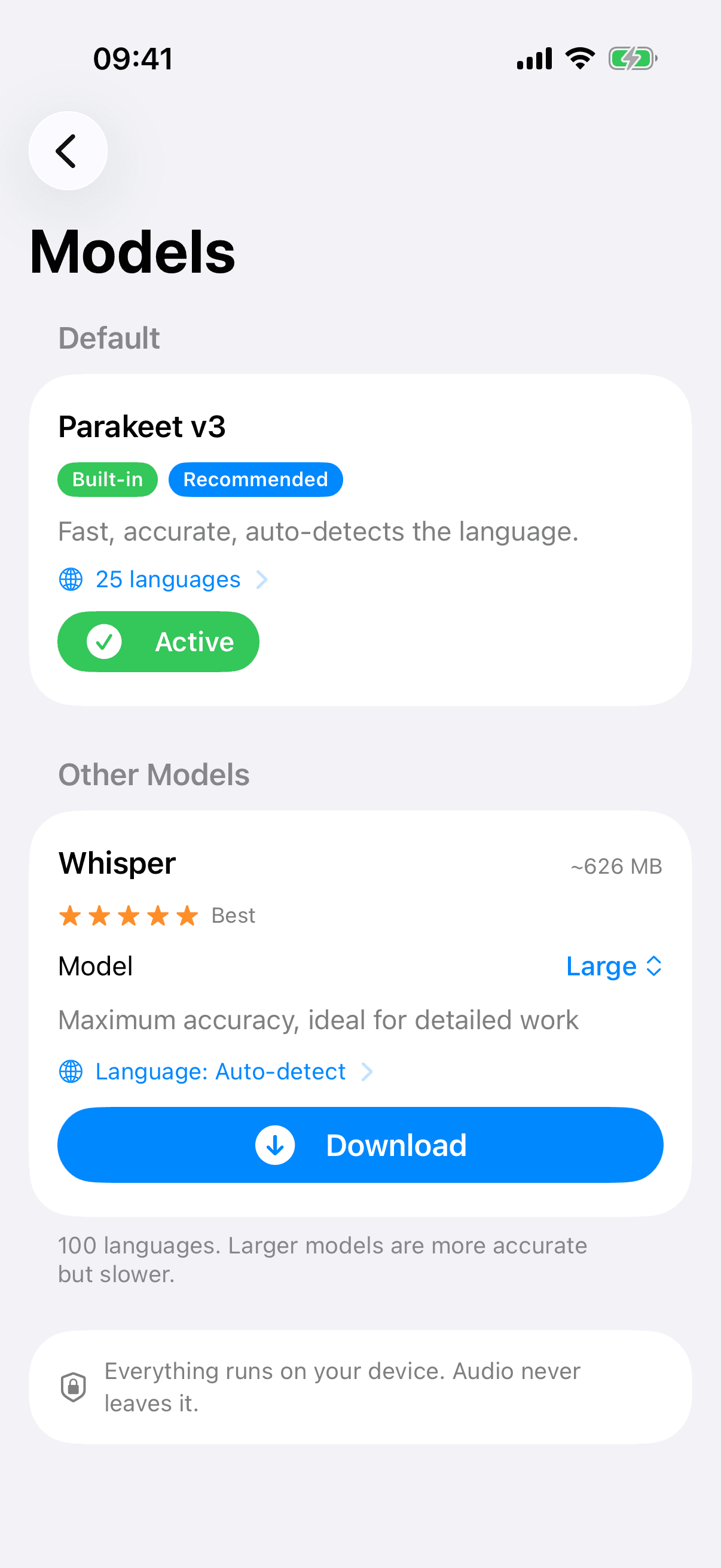
ScribeKit uses Argmax's open-source WhisperKit to run Whisper on Apple's Neural Engine, with the Core ML builds Argmax publishes on Hugging Face. The Models screen offers five, with these sizes and descriptions in the app:
| In ScribeKit | Download | Built from | The app's description |
|---|---|---|---|
| Tiny | about 75 MB | whisper tiny | Fastest option, good for quick voice notes |
| Base | about 145 MB | whisper base | Good balance for everyday transcription |
| Small | about 470 MB | whisper small | Higher accuracy, handles accents well |
| Large Turbo | about 632 MB | large-v3-turbo | Best speed-to-quality ratio for long recordings |
| Large | about 626 MB | large-v3-turbo | Maximum accuracy, ideal for detailed work |
To be precise about the two large options: both are Argmax's compressed Core ML builds of OpenAI's large-v3-turbo checkpoint (Argmax names it large-v3-v20240930). Argmax's OpenBench notes describe the 626 MB file as a "compressed Whisper Large V3 Turbo model." Neither is the full 1550 M-parameter large-v3, which would be too heavy for most phones.
How they behave in the app:
- Pro only, downloaded once. Each model comes from its public repository on Hugging Face the first time you choose it. That download is the only time it needs the internet; afterwards it runs offline. Models are excluded from your device backup because they can be downloaded again.
- Only what your device can run. WhisperKit carries a table of which models each Apple chip supports. ScribeKit only lists those, and preselects the highest one your device supports.
- 90-minute cap. Whisper decodes the whole file in memory, so while a Whisper model is active, recordings and imports are capped at 90 minutes. Parakeet is capped at 3 hours in Pro.
- Language choice. Whisper detects the language or lets you pick it, which helps with accents and code-switching. Parakeet always auto-detects.
How does ScribeKit run Parakeet on an iPhone?
Parakeet ships inside the app. ScribeKit uses FluidAudio's Core ML conversion of Parakeet TDT v3: four compiled models (preprocessor, encoder, decoder and joint network) plus the vocabulary, bundled in the app download. That is why ScribeKit is about half a gigabyte, and why it transcribes in Airplane Mode from the very first launch, with no model download at all.
ScribeKit groups Parakeet's word timings into segments at sentence-ending punctuation, so every sentence in the transcript is tied to a start and end time you can tap to hear. Whisper produces its own segments, and ScribeKit uses those as they come.
I covered the whole pipeline, from microphone to segments, in how ScribeKit transcribes on your phone.
Parakeet vs Whisper: which should you use?
Here is how I would choose, based on the published cards and on how the two models are packaged in the app. It is a starting point, not a benchmark.
| Your situation | Start with | Why |
|---|---|---|
| English or a major EU language, Russian, Ukrainian | Parakeet | Built in, auto-detects, low published error rates |
| Chinese, Japanese, Korean, Arabic, Hindi, Turkish and others outside the 25 | Whisper Small, then Large Turbo | Parakeet does not support them |
| Latvian, Slovenian, Greek, Danish, Swedish | Parakeet, then compare with Whisper | Higher published error rates for Parakeet in these |
| Recordings longer than 90 minutes | Parakeet | Whisper is capped at 90 minutes in ScribeKit |
| Little free storage or an older device | Parakeet, or Whisper Tiny or Base | Parakeet needs no extra download |
| Strong accents, noise, mixed languages | Try both | Results vary by recording |
"Try both" is cheap in ScribeKit: switch the active model on the Models screen, open a transcript and choose Re-transcribe. The audio stays on the phone, and you compare the two texts against the audio by tapping the segments.
On model size: bigger Whisper models are more accurate on OpenAI's published charts and take longer and more memory to run. On a phone, the honest advice is to start with Small and move up only if the errors bother you. Large Turbo and Large are worth it on a recent iPhone or iPad, mainly for languages Parakeet does not cover.
How do I check which model an iPhone app really uses?
Other iPhone apps run Whisper or Parakeet too, and a model name on an App Store page tells you less than you might think. Look for three things: which model runs by default, whether it ships inside the app or downloads after you install, and whether any part of the work (transcription, summaries, a "turbo" mode) goes to a server instead.
Then test it in Airplane Mode with a recording that sounds like your real ones. Our guide to offline transcription on iPhone walks through what to check.
What doesn't either model do in ScribeKit?
Neither model, as ScribeKit uses them, labels speakers, produces a live transcript while you record, summarizes, or translates. ScribeKit is a transcriber for iPhone and iPad: you record or import, and you get timestamped text you can search, tap and share. ScribeKit is free with the built-in Parakeet model, for 10 transcriptions a month, up to 30 minutes each; ScribeKit Pro adds the Whisper models, recordings up to 3 hours and no monthly limit.